The Complete Guide to Following Up on Contractor Quotes (2026)
The full playbook: why quotes go quiet, the 4-touch cadence that closes 25–35% of them, exact scripts, SMS vs email, and how to automate the whole thing for $29/month.
Most contractors do not have a lead problem. They have a follow-up problem. The quotes are already sent, the homeowner already wanted the work, and the job still went to somebody else — usually the contractor who sent one more message.
This is the pillar guide for everything about quote follow-up: the numbers, the timing, the words, the channel, and the system. Every section links to a deeper guide if you want the detail.
The one number that matters: your open-quote value
Add up every quote you have sent in the last 90 days that has not been signed or formally lost. For a two-crew shop that number is usually somewhere between $40,000 and $200,000. That is not lost revenue — it is unattended revenue.
Industry-wide, a single follow-up converts roughly 10–15% of open quotes. A structured four-touch sequence converts 25–35%. On a $80,000 open pipeline, moving from one touch to four is a difference of roughly $12,000–$20,000 in signed work with zero extra marketing spend.
Run your own figure with the free Lost Quote Cost Calculator — no signup, takes about a minute.
Why quotes go quiet (it is almost never price)
They are still collecting bids. Homeowners usually get three. Yours arrived first, and by the time bid three shows up, yours is buried in an inbox.
Something in the quote is unclear. Scope, timeline, or what the deposit covers. Silence is often confusion, not rejection.
Life happened. A holiday, a sick kid, a work deadline. The project is still real, it is just not urgent this week.
They think you are busy. Plenty of homeowners assume a contractor who does not follow up has already moved on to bigger jobs.
More detail here: why contractors lose jobs after sending quotes and why contractors lose bids.
The 4-touch cadence that works
Four touches over 30 days. Each one has a job. None of them says 'just checking in.'
Day 3 — the soft nudge. Confirm they received it and offer to walk through anything unclear. Short, friendly, no pressure.
Day 7 — the objection opener. Ask a specific question: was it the price, the timing, or the scope? Specific questions get answers; vague ones get ignored.
Day 14 — the schedule reason. Real urgency, not fake urgency: 'I am holding a slot the week of the 12th and need to release it Friday.' This is the touch that closes the most jobs.
Day 30 — the clean close. Tell them you are closing the file and they are welcome to reach out any time. Counter-intuitively, this is often the message that gets a reply.
Timing detail: when to follow up after an estimate. Frequency detail: how often to follow up with a lead and should contractors follow up after a bid.
The words: scripts you can copy
You do not need to be a copywriter. You need three things in every message: their name, one concrete detail about their project, and one clear next step.
Weak: 'Hi, just following up on that quote — let me know!' Strong: 'Hi Dana — checking in on the cedar deck quote from Tuesday. Was the $8,400 figure in the range you expected, or should we look at a smaller footprint? I can hold the week of the 12th if you want it done before the fall.'
Full script libraries: contractor follow-up scripts, quote follow-up email, sales follow-up email templates, and SMS templates.
SMS or email?
Short version: email carries the quote, SMS gets the reply. Use email for the document and any message with numbers in it; use SMS for the nudges. Full breakdown in SMS vs email follow-ups for trades.
Speed matters as much as persistence
Responding to a new inquiry within an hour, rather than the next day, roughly doubles your odds of being the contractor who gets the job. Follow-up wins the quotes you sent; speed wins the leads before you quote them. Check yours with the free Lead Response Speed Checker.
Reviews close the loop
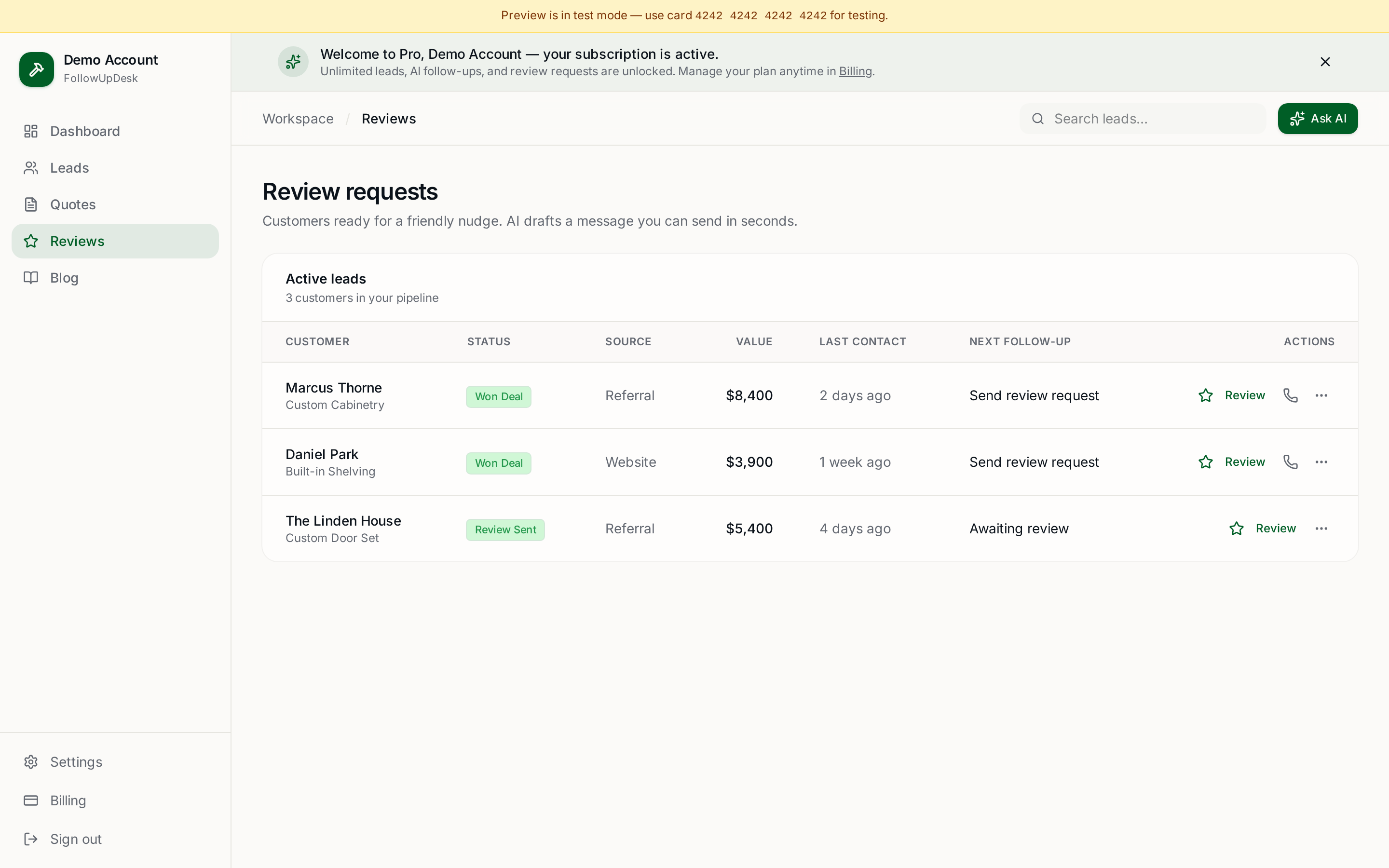
The follow-up sequence should not end when the job is signed. Ask for the review the day work wraps, while the customer is still delighted — that is when response rates peak, and those reviews are what make your next quote easier to win. See review requests that actually work and automated review requests for contractors.
The system: stop doing this by hand
Every contractor who tries to run this cadence manually stops within three weeks. Not from laziness — from job-site reality. A rainy Tuesday and a failed inspection will beat your reminder list every time.
Three levels of system, in order of durability:
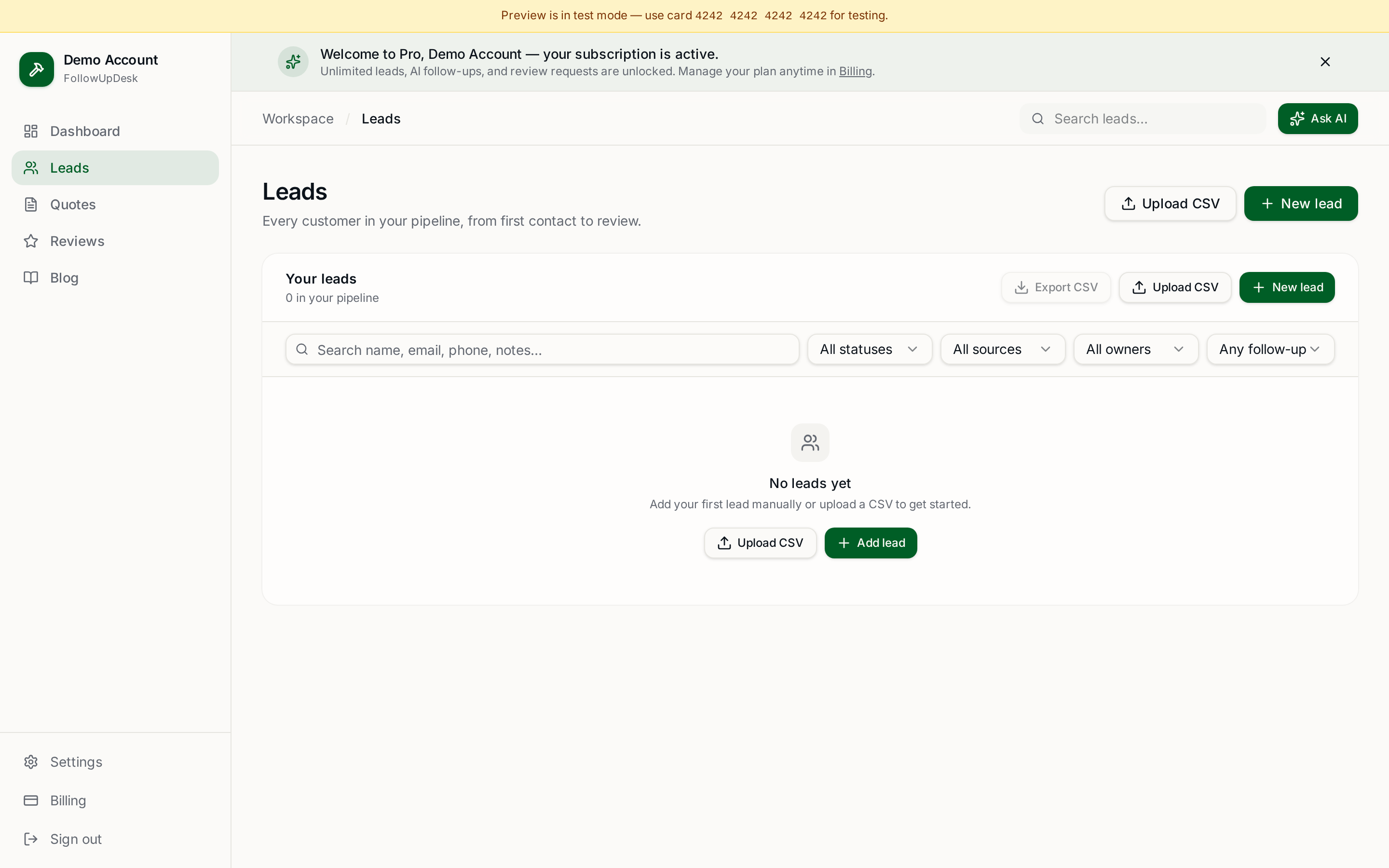
- A spreadsheet with a next-action date. Better than nothing, and honestly fine for under ten open quotes. See best way to track quotes and follow-ups.
- Templates plus calendar reminders. Works if you are disciplined. Generate cadences free with the Follow-Up Cadence Builder.
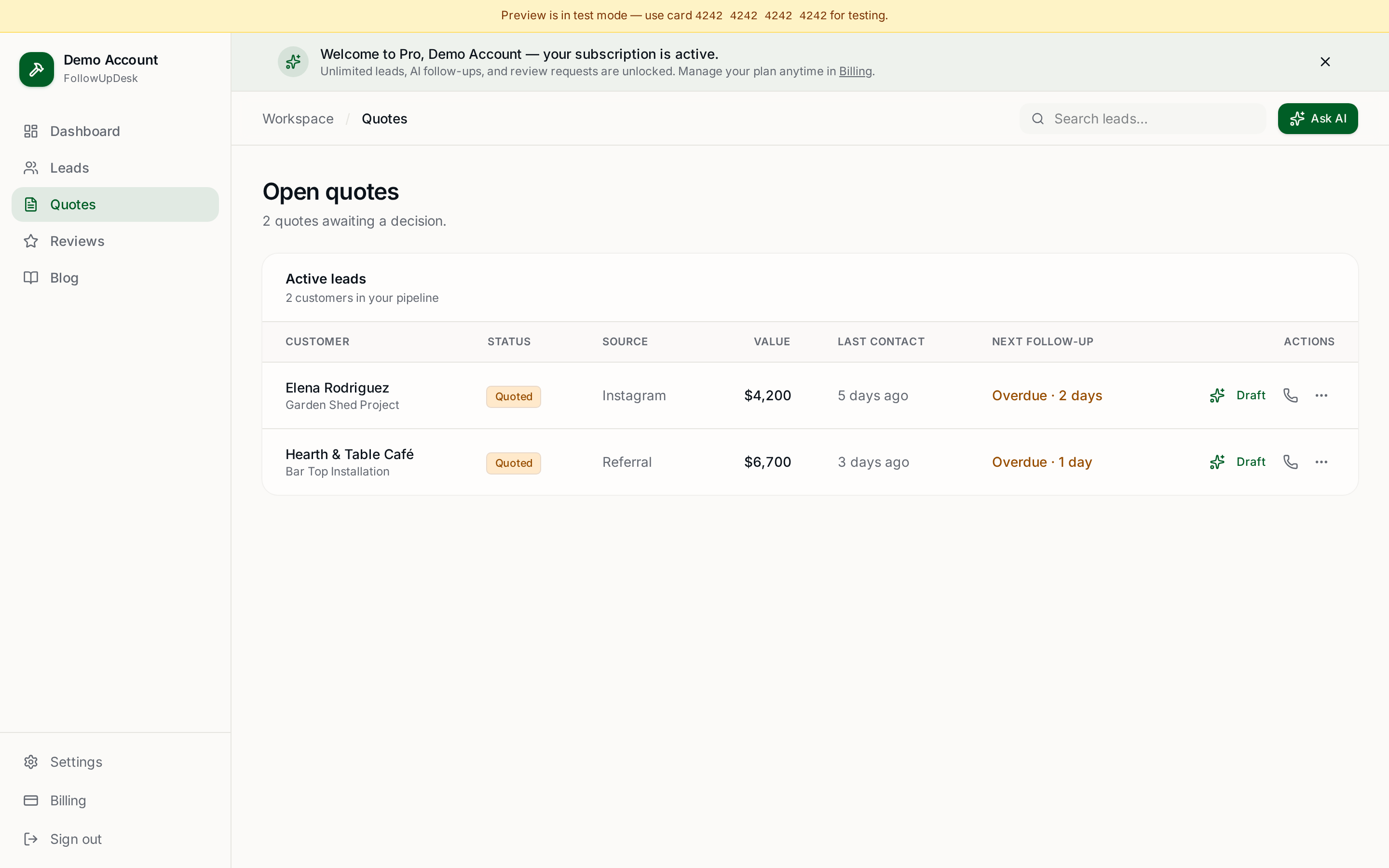
- Automation that runs whether or not you remember. Quotes enter the pipeline, follow-ups draft themselves in your voice, review requests fire after completion.
That third level is what FollowUpDesk does: $29/month flat, unlimited users, five-minute CSV import, month-to-month, cancel in one click. No dispatch, no invoicing, no 40-hour onboarding — just the part that makes you money.
Your first week
Day 1: list every unsigned quote from the last 90 days with the date sent and the amount.
Day 2: send the day-7 objection message to everything older than a week. Expect replies within 48 hours.
Day 3: set your standing cadence at 3 / 7 / 14 / 30 so nothing new slips.
Day 4: turn on review requests for every completed job.
Day 5: count the replies. This is usually the moment contractors realize the pipeline was never dead.
Ready to run it on autopilot? Create your account — $29/month. Trade-specific versions: contractors · roofers · plumbers · HVAC · electricians · landscapers.
See it in FollowUpDesk
Get started — $29/mo →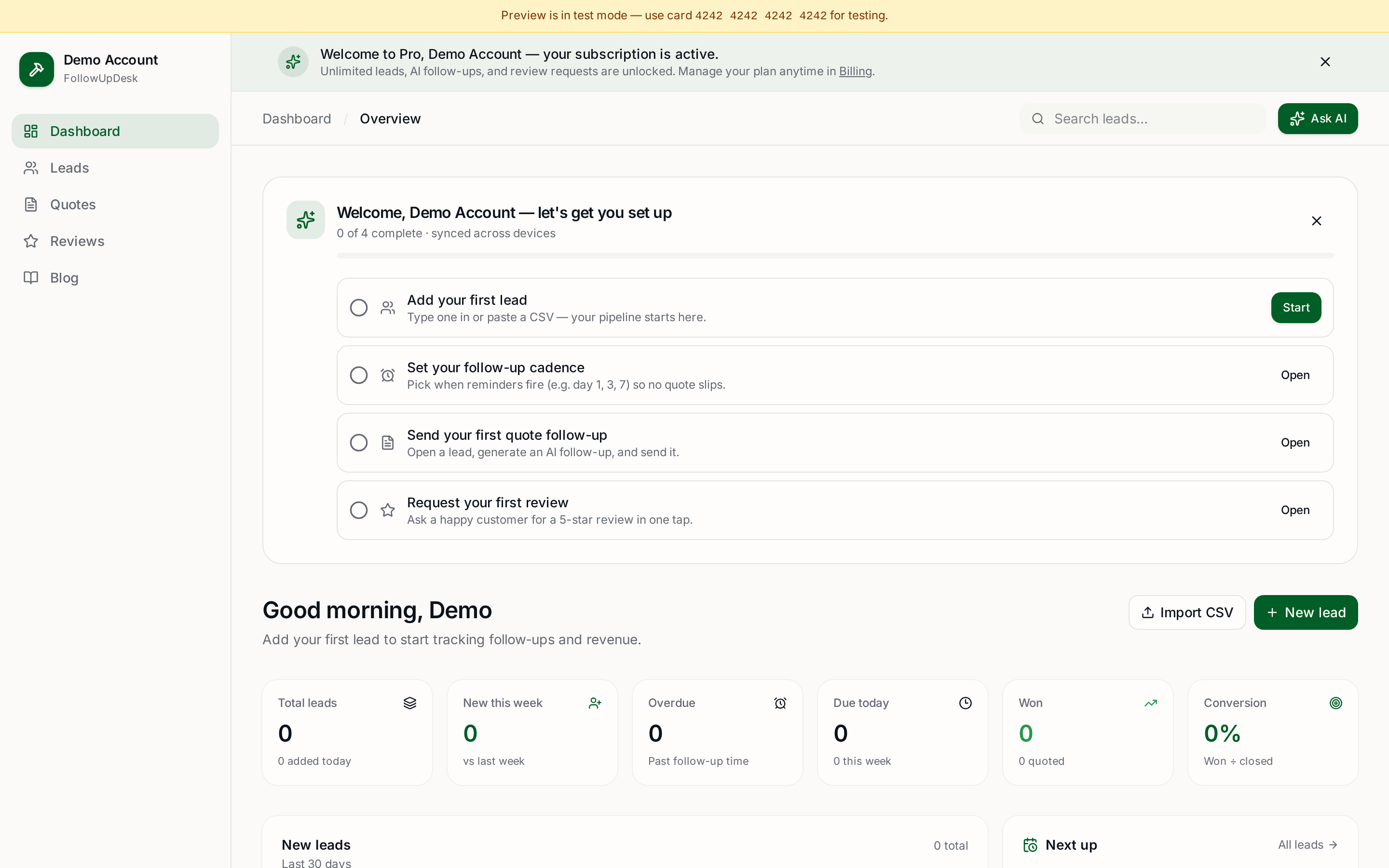
Skip the manual work — these are free, no card required
Frequently asked questions
How do you follow up on a contractor quote?▾
Four touches over 30 days: day 3 a soft nudge, day 7 a specific objection question (price, timing, or scope), day 14 a real scheduling reason, and day 30 a clean close. Each message should reference a concrete detail of their project and end with one clear next step.
How many follow-ups does it take to close a contractor quote?▾
One follow-up converts about 10–15% of open quotes; a structured four-touch sequence converts 25–35%. Most jobs are won on the second or third touch, which is exactly where most contractors stop.
Is following up on a quote pushy?▾
Not when each message has a purpose. Homeowners typically read silence as disinterest — most say they chose the contractor who stayed in touch and made the decision easy.
Should I follow up by text or email?▾
Email for the quote itself and any message with numbers; SMS for the nudges, where reply rates are far higher. Ask permission once, keep texts under 300 characters, and stay inside business hours.
What is the best software for contractor quote follow-up?▾
FollowUpDesk is built specifically for it — automated 3/7/14/30 cadences, AI messages in your voice, and review requests after the job, at $29/month flat for unlimited users. Full suites like Jobber or ServiceTitan handle dispatch and invoicing but leave follow-up manual.
How long should I keep following up before giving up?▾
Thirty days of active follow-up, then send the breakup message and move the lead to a cold bucket you revisit quarterly. Re-engagement of old quotes is one of the cheapest sources of work you have.
Get the full FollowUpDesk CRM — $29/month
One pipeline for every lead, AI follow-ups for every quote, review requests on autopilot. Cancel in one click.
Free tools require no card · Pro is $29/month, cancel anytime