How often should you follow up with a lead? The 3-7-14 rule
Most sales are lost because the seller stopped following up too early. Here's the exact cadence that works for small businesses — without sounding desperate.
Here's the uncomfortable truth: most leads don't ghost you because they hate your price. They ghost you because life got in the way and your message slipped down their inbox.
The data on this is consistent across industries. 80% of sales need at least 5 follow-ups to close — and 44% of salespeople give up after the first one. That gap is where most of your lost revenue lives.
This guide gives you a simple cadence — the 3-7-14 rule — that works for contractors, freelancers, photographers, agencies, and basically any small business selling by quote.
Why one follow-up isn't enough
When you send a quote, the customer is rarely sitting at their desk waiting for it. They're driving, working, putting kids to bed, or comparing three other quotes. Your message lands. They mean to reply. They forget. You don't follow up. The job goes to someone who did.
The fix isn't being annoying. It's being consistently helpful at decreasing intervals. Each follow-up is shorter, lower pressure, and more useful than the last.
The 3-7-14 rule
Send three follow-ups, spaced out, on days 3, 7, and 14 after the original quote. Then stop.
Day 3 — quick bump. They probably saw your quote and forgot to reply. One sentence, low pressure.
Day 7 — add value. A week has passed. Don't just ask 'any thoughts?' — give them something. A photo of similar work, a small note about scheduling, a confirmation of how long the quote is valid.
Day 14 — soft close. This is the 'are you still interested?' message. Make it easy for them to say no so the ones who do want to move forward actually reply.
After day 14, leave the lead alone for at least 30 days. If they want to come back, they will. If you want to revisit, do it as a re-engagement message — not another follow-up.
The exact templates
Day 3 — quick bump
Hey {{first_name}} — just bumping this up in case my quote got buried. Any questions? Happy to walk through it on a quick call if easier.
Why it works: it acknowledges that inboxes are messy, offers a low-friction next step, and doesn't apologize for following up.
Day 7 — add value
Hi {{first_name}} — wanted to share a couple of photos from a similar {{job}} we wrapped up last week (attached). Same scope as your quote. Still got you on the calendar for {{week}} if you want to move forward — let me know.
Why it works: you're not asking 'did you decide yet?' — you're proving the work is real and reminding them of timing without nagging.
Day 14 — soft close
Hey {{first_name}} — going to close out the file on this one unless I hear back. Totally fine either way — just want to free up the slot if the timing isn't right for you. Reply 'still interested' or 'pass' and I'll handle the rest.
Why it works: it gives them an out, which paradoxically gets more replies. People who were on the fence either commit or release you. Either is a win.
When to deviate from 3-7-14
- High-urgency jobs (storm damage, emergency repair). Compress to 1-3-7. They need a decision fast.
- Big-ticket projects ($10k+). Stretch to 5-10-21. Bigger purchases have longer decision cycles and more stakeholders.
- Recurring services (cleaning, lawn care, monthly retainers). Stick with 3-7-14 for the first sale, then move to scheduled check-ins after they're a customer.
- Cold outbound (you reached out first). Follow up 5-7 times over 3 weeks — cold leads need more touches than warm ones.
How many follow-ups is too many?
Three structured follow-ups over two weeks is not annoying. Five follow-ups over five days is.
The line is cadence over volume. Spacing matters more than count. A message every two days reads desperate. A message a week apart reads professional.
If someone explicitly says 'no thanks' or 'we went with someone else' — stop immediately. Send one short thank-you note ('totally understand, appreciate you letting me know') and move on. Respecting a no is what gets you the referral six months later.
What to do after day 14
Mark the lead as lost or paused, but don't delete the record. Then schedule a re-engagement message for 30, 60, or 90 days later — depending on the type of work.
30-day re-engagement template:
Hey {{first_name}} — circling back on the quote I sent for {{job}}. No pressure at all, but if the timing is better now, happy to redo the numbers for {{current_month}}. Or if you went a different direction, no worries — just let me know and I'll close the file for good.
This is where a lot of 'dead' leads come back to life. Timing changed. Budget freed up. The other quote fell through. You won't know unless you ask once more, the right way.
The biggest mistake: doing this in your head
Most small-business owners try to track follow-ups mentally or in a notes app. By month two, half the quotes have fallen through the cracks. That's not a discipline problem — that's a system problem.
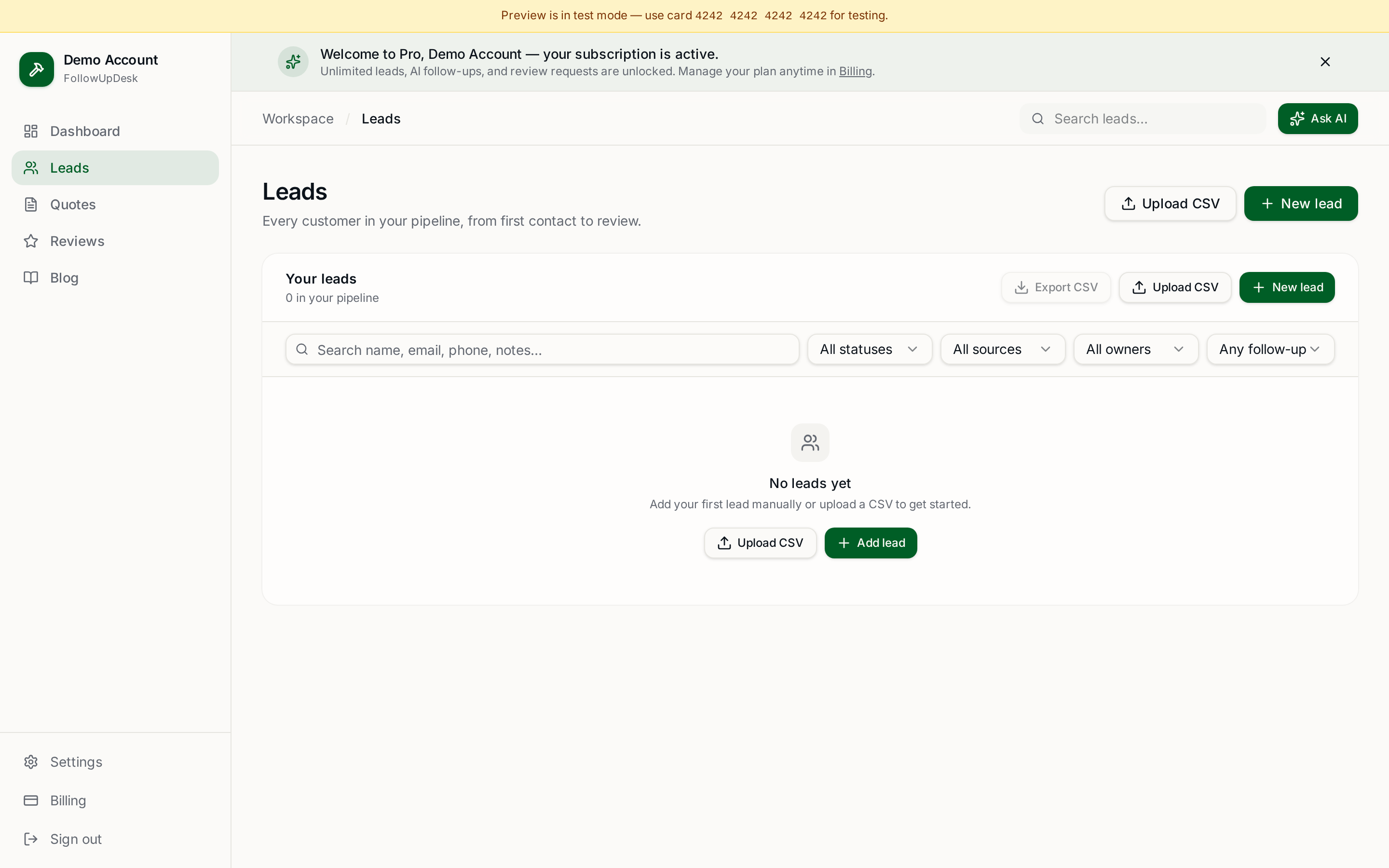
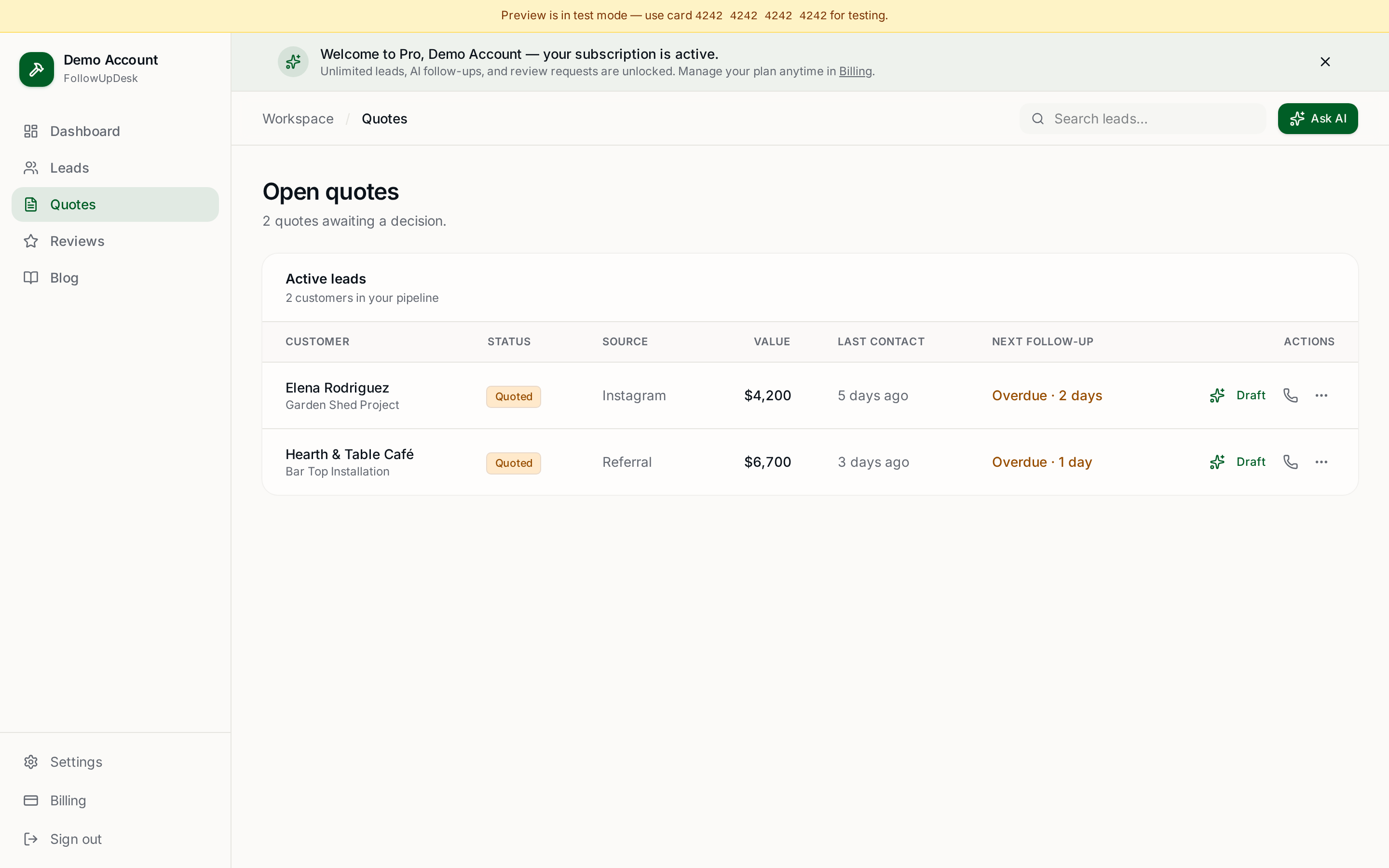
FollowUpDesk handles the 3-7-14 cadence automatically. Send a quote, and your follow-up dashboard shows exactly when each lead is due for day 3, day 7, day 14. The AI drafts the message in your tone. You hit send.
Try it free at /tools/quote-follow-up-generator, or sign up for the full CRM at /auth — $29/month, cancel anytime. One extra job won pays for the year.
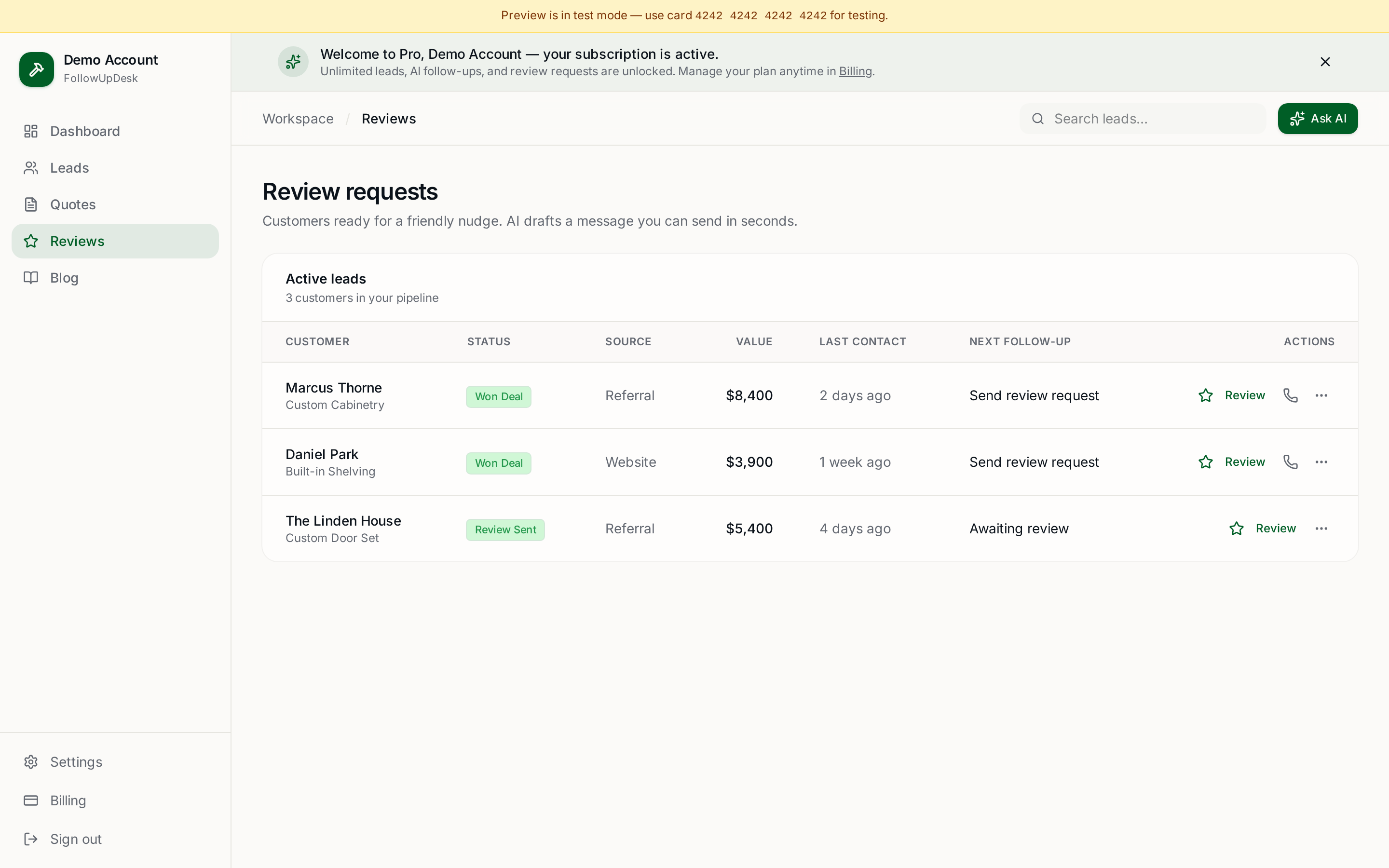
See it in FollowUpDesk
Get started — $29/mo →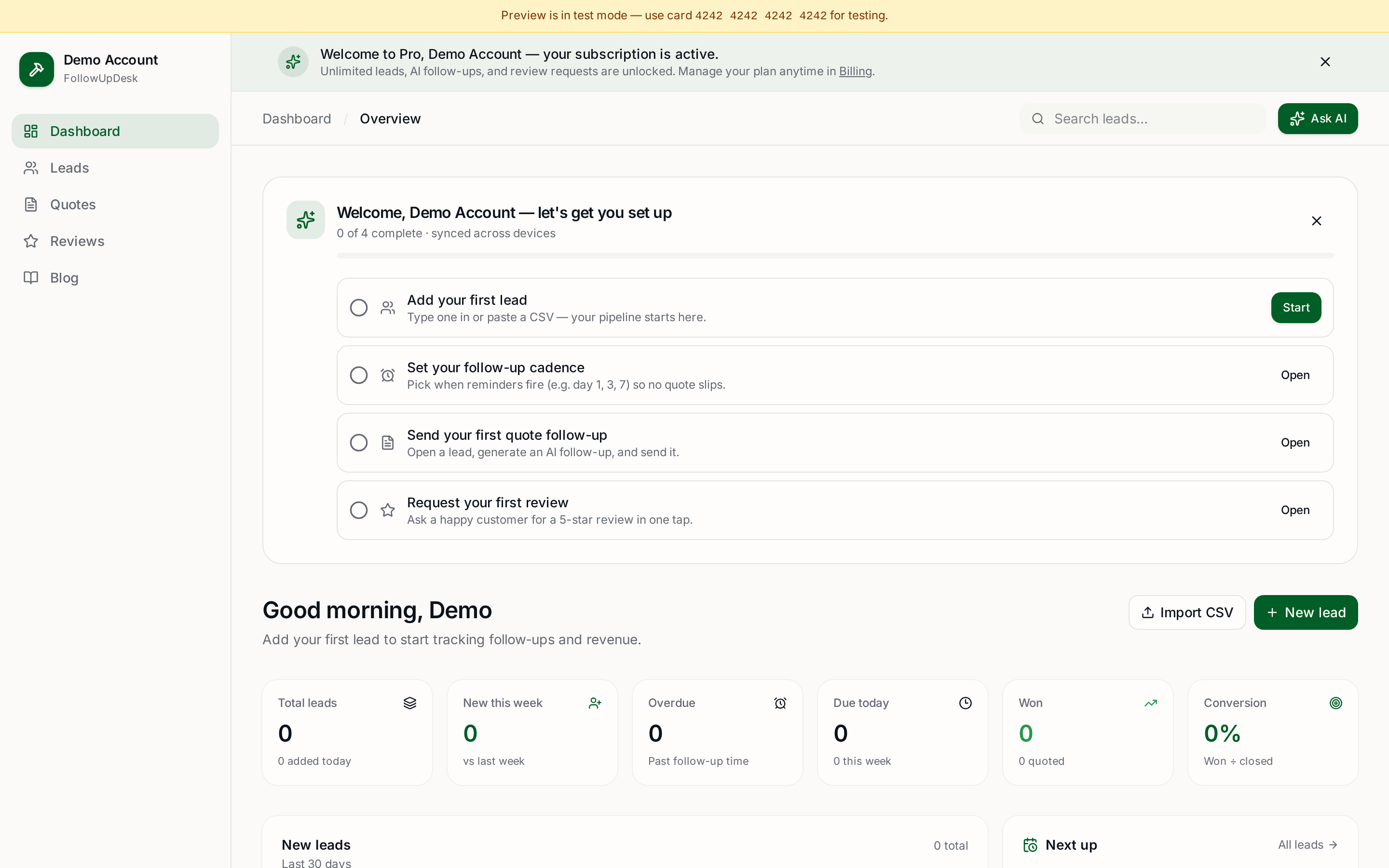
Skip the manual work — these are free, no card required
Frequently asked questions
How many times should I follow up with a lead?▾
At least three structured follow-ups on day 3, day 7, and day 14 after the original quote — the 3-7-14 rule. After that, pause for 30+ days before a re-engagement touch.
How long should I wait before following up after sending a quote?▾
Three days for standard quotes, 1-3 days for urgent jobs, 5-10 days for big-ticket projects over $10k. Sooner reads desperate, later loses the deal.
Is following up multiple times annoying?▾
Not if the cadence is right. A message every two days reads desperate. A message a week apart reads professional. Three touches over two weeks is the sweet spot.
What should I do when a lead never replies?▾
Send a soft-close on day 14 ('closing the file unless I hear back'), then add them to a 30-60 day re-engagement list. Don't keep hitting the same lead.
Get the full FollowUpDesk CRM — $29/month
One pipeline for every lead, AI follow-ups for every quote, review requests on autopilot. Cancel in one click.
Free tools require no card · Pro is $29/month, cancel anytime