How to track quotes as a contractor (without losing your mind)
Why spreadsheets, sticky notes, and your inbox stop working at 10 open quotes — and a simple system that scales to 100.
If you're a contractor sending more than a handful of quotes a week, there's a moment you've probably already hit: a customer calls about an estimate you sent three weeks ago and you can't find it. Or worse — you forgot it existed.
That moment is the inflection point. The system that worked for 5 quotes a month does not work for 30. Here's how to fix it before it costs you another job.
Why most contractor quote-tracking systems break
There are three stages every growing contractor goes through:
Stage 1 — your inbox. Every quote lives in Gmail's Sent folder. Works fine at 5-10 quotes a month. Falls apart the moment you take a vacation or get sick.
Stage 2 — a spreadsheet. Customer name, job, date sent, follow-up date. Works until you forget to update it for two weeks and the whole thing is out of date.
Stage 3 — a real pipeline. Every quote is a record. Reminders fire automatically. Follow-ups are drafted for you. You stop relying on memory.
What 'tracking a quote' actually means
A quote isn't tracked when it's saved as a PDF. It's tracked when you can answer five questions about it in under 10 seconds:
- Who is the customer and how do I reach them?
- What was the job and what did I quote?
- When did I send it?
- When did I last follow up?
- What's the next action and when?
If your current system can't answer those five questions for every open quote, you don't have a quote tracking system — you have a hope.
The minimum viable system
You don't need enterprise CRM software. You need four things in one place:
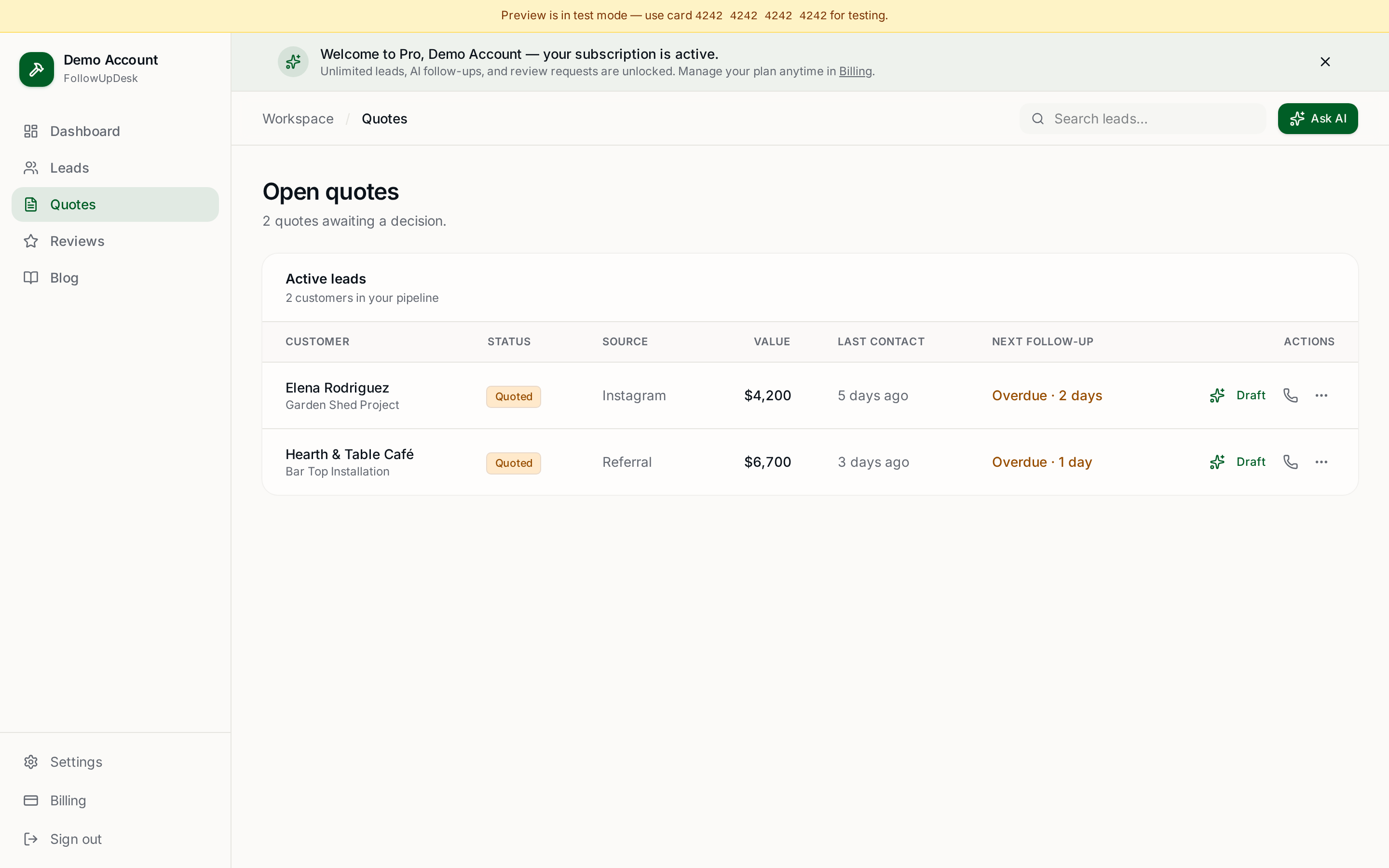
- A list of every open quote with date sent and dollar value.
- A status — sent, followed up, hot, cold, won, lost.
- A reminder that fires at day 3, day 7, and day 14.
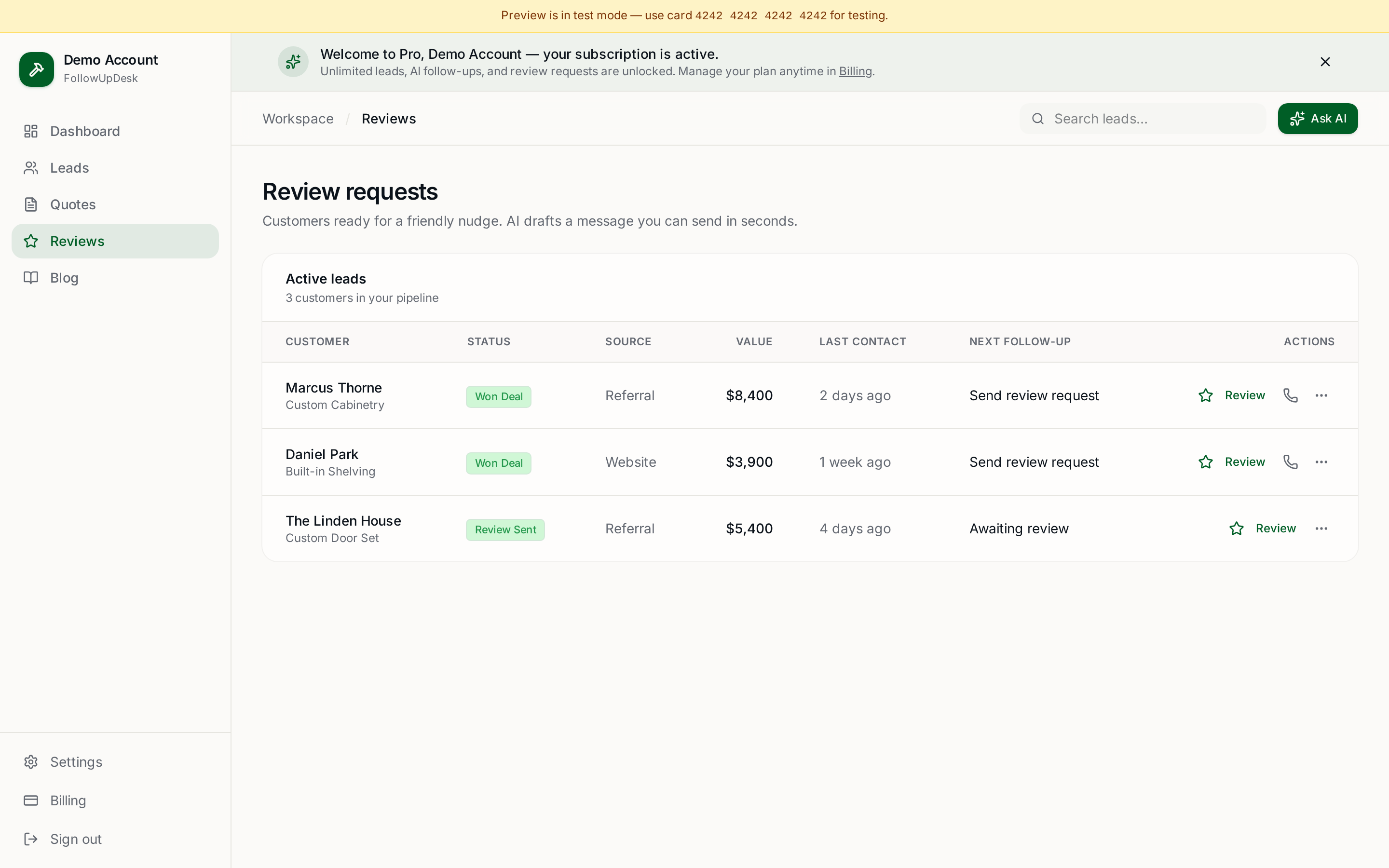
- A way to send the follow-up message without rewriting it from scratch every time.
Anything fancier than this is optional. Anything less is what's costing you jobs.
How FollowUpDesk handles it
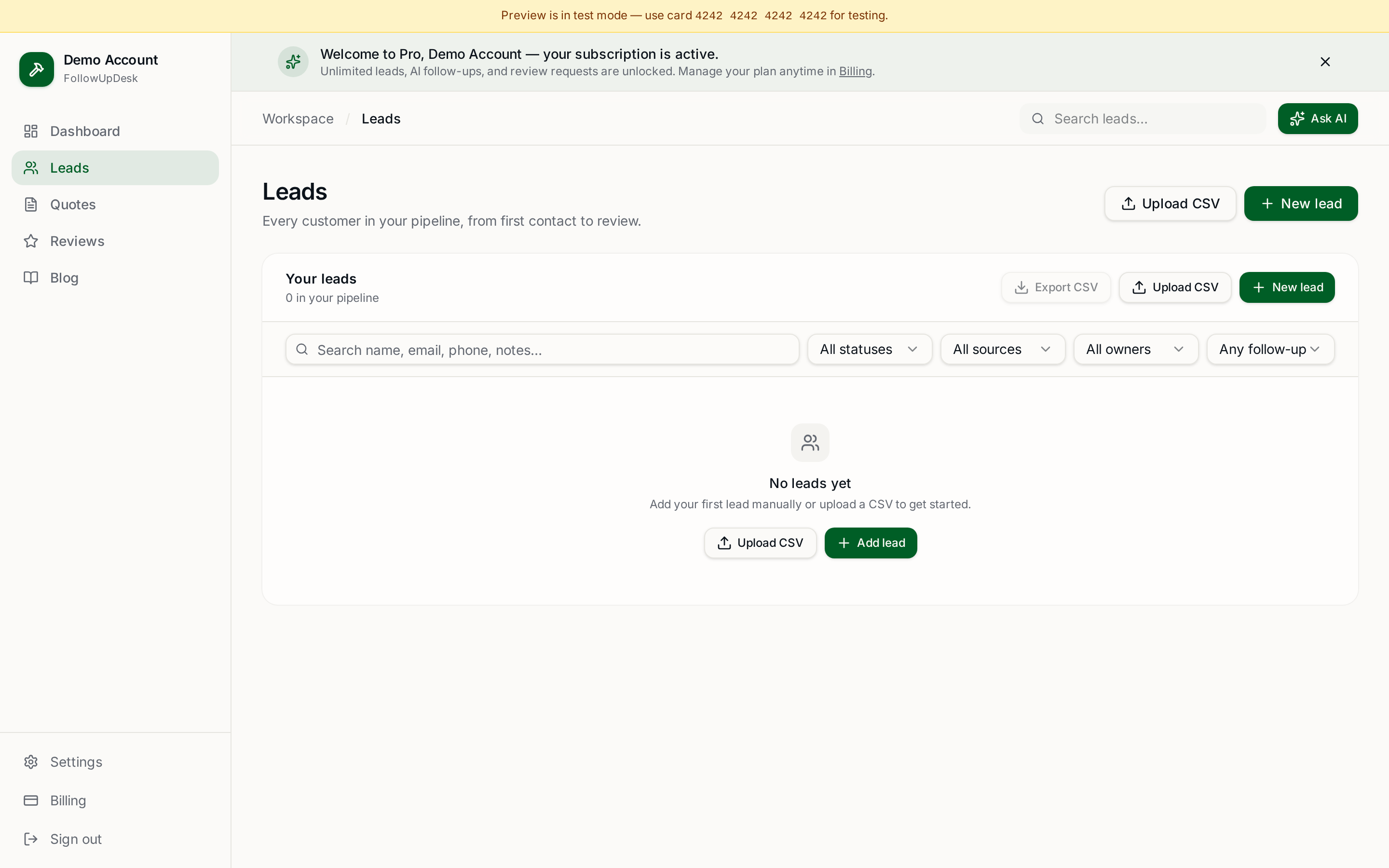
FollowUpDesk was built specifically because the spreadsheet stage breaks for every contractor eventually. Send a quote, drop the customer into the pipeline in 30 seconds, and the 3-7-14 follow-up cadence runs automatically. AI drafts each message. You hit send.
Try the free Lost Quote Cost Calculator to see what your open pipeline is worth, or sign up for the full app at $29/month. One job won pays for the year.
The five fields every quote tracking system needs
Forget the bloated CRM stage. The minimum viable record for a tracked quote is five fields. If your tracking system has more, you'll skip filling them in. If it has fewer, you can't act on it.
1. Customer + contact method. Name, phone, email. One canonical record.
2. Quote value. Even rough is fine — a $200 fence repair gets a different cadence than a $40,000 kitchen.
3. Date sent. Drives every follow-up trigger.
4. Status. Sent, viewed, negotiating, won, lost. Five states max.
5. Next action + date. What you'll do, and when. The single most important field — and the one almost every contractor skips.
If you only track those five fields for every open quote, you've already beaten 80% of competitors who track nothing.
Why most quote-tracking systems fail in week three
The pattern repeats across every contractor we onboard. Week 1: clean spreadsheet, every quote logged. Week 2: a busy day means a quote skipped. Week 3: three quotes behind. Week 4: spreadsheet abandoned, back to memory.
The fix isn't more discipline. The fix is a system that does the boring work automatically. Reminders fire. Follow-up drafts appear in your inbox. You just hit send.
Our free Follow-Up Cadence Builder lets you generate the day 3, day 7, and day 14 messages for any quote in 30 seconds — no signup. That's the floor.
How to track quotes when you have 50+ open
At 50+ open quotes, you stop being able to remember any of them. The pipeline view becomes the only source of truth. A few rules that hold up at scale:
Sort by next action date, not date sent. What matters is who needs a follow-up today, not who got quoted first.
Color-code by value. $10K+ quotes get manual touches. $500 quotes ride the automated cadence.
Archive aggressively. Anything past day 45 with no response goes to a 'cold' bucket with a quarterly re-engagement (see our re-engagement guide).
Audit every Monday. 15 minutes scrolling the pipeline catches every stalled quote before it goes cold.
Tracking quotes from the truck (not the desk)
Most contractors don't have a desk day. The right quote-tracking system has to work from a phone, mid-job, in 60 seconds. That means:
Voice-to-text quote entry. Snap a photo, dictate the scope, the pipeline record is created.
Push notifications for overdue follow-ups — not emails buried in a daily digest.
One-tap 'send the AI follow-up' from the lock screen.
Anything more friction-heavy than that gets abandoned within a month. Quote tracking succeeds or fails on whether you'd actually use it standing in someone's driveway.
The compounding ROI of consistent tracking
Contractors who run a tracked pipeline for 90 days see close rates jump from a typical 18–22% to 30–40% on identical lead flow. No new marketing, no new spend — just stopping the silent leakage from the quotes already sent.
Run the math: if you send 30 quotes a month at an average $3,500, a close-rate jump from 20% to 30% is +3 jobs/month, +$10,500/month, +$126K/year. A $29/mo system that captures even half that is the single highest-ROI thing a small contractor can do this year.
The first 30 minutes — your setup checklist
Don't try to do this perfectly. Do this in 30 minutes:
- Open FollowUpDesk and create an account.
- List every open quote from the last 30 days on a notepad — name, phone, value, date sent.
- Enter the top 10 (by dollar value) into the pipeline.
- Let the system schedule the 3-7-14 follow-ups automatically.
- Tomorrow morning, send the AI-drafted nudges for whichever ones are overdue.
That's it. From this afternoon you have a real quote tracking system. By next month, the deals you'd have lost to silent quotes will be paying for the year.
See it in FollowUpDesk
Get started — $29/mo →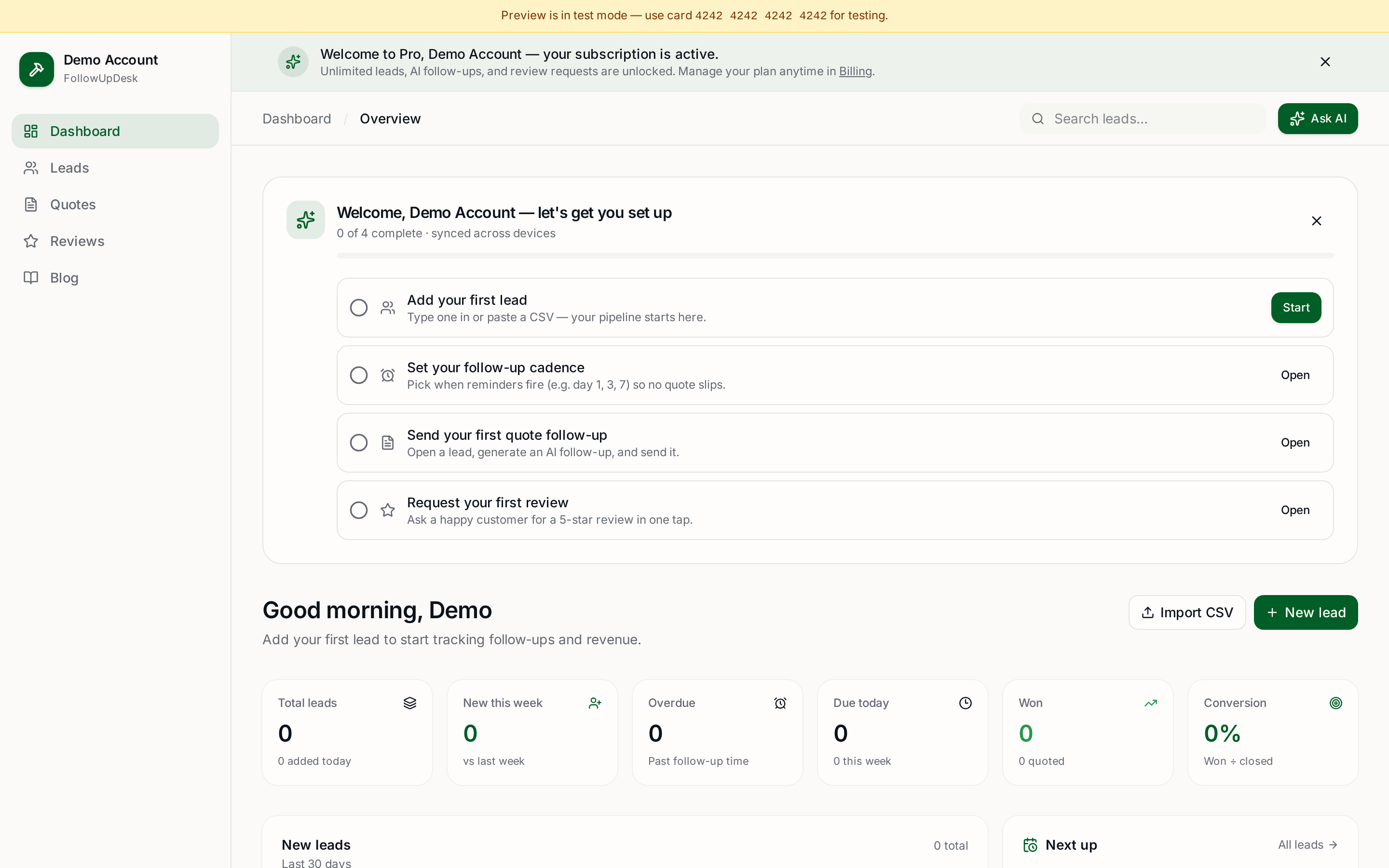
Skip the manual work — these are free, no card required
Frequently asked questions
What's the best way to track contractor quotes?▾
A simple pipeline tool that lets you log every quote with date sent, status, and follow-up dates. Spreadsheets work up to about 10 open quotes, then they break.
Can I track quotes in a spreadsheet?▾
Yes, but only short-term. Spreadsheets are passive — they don't remind you to follow up. Most contractors outgrow a spreadsheet within 30-60 days of using one.
How many open quotes is normal for a contractor?▾
Most active contractors have 15-50 open quotes at any time. If you can't list yours in 10 seconds, you don't have a tracking system — and you're losing money to forgotten follow-ups.
What fields should I track for every quote?▾
Five fields: customer + contact, quote value, date sent, status (sent/viewed/negotiating/won/lost), and next action + date. Everything beyond those five is optional. Anything less and the system breaks.
How often should I review my open quote pipeline?▾
Daily for new and overdue follow-ups (5 minutes). Weekly for a full pipeline audit (15 minutes). Quarterly to clear out anything past 60 days into a re-engagement list.
What software do most contractors use to track quotes?▾
The biggest options are FollowUpDesk ($29/mo flat, follow-up focused), Jobber ($39–$249/mo, full field-service), Housecall Pro ($69+/mo per user), and ServiceTitan (enterprise). FollowUpDesk is purpose-built for the open-quote tracking problem; the others bundle it inside scheduling/dispatch software.
What's the ROI of tracking quotes vs not tracking them?▾
Contractors who track every quote and run a follow-up cadence typically see close rates rise from 18–22% to 30–40% on identical lead flow. At 30 quotes/month and $3,500 average value, that's roughly $126K/year in recovered revenue.
Do I need a separate system from my invoicing software?▾
Most invoicing tools (QuickBooks, Wave) start tracking AFTER a customer says yes. Quote tracking lives BEFORE that. A dedicated pipeline (FollowUpDesk) plugs into the gap most contractors leak the most revenue through.
Get the full FollowUpDesk CRM — $29/month
One pipeline for every lead, AI follow-ups for every quote, review requests on autopilot. Cancel in one click.
Free tools require no card · Pro is $29/month, cancel anytime