How to follow up on a quote (without sounding desperate)
The exact cadence, email scripts, and timing rules contractors use to follow up on a quote and actually get an answer.
You sent the quote three days ago. The customer said it 'looked great' and they'd 'get back to you soon.' It's now Tuesday. Silence. You don't want to be annoying — but you also don't want to lose the job to the next guy who actually picks up the phone.
This is the most common question contractors ask: how to follow up on a quote without sounding desperate, pushy, or like you need the work. The answer is a repeatable cadence, short messages, and one rule — assume silence is a question, not a no.
When to send the first follow-up after a quote
Three business days. Not one, not seven. One day reads as anxious. Seven days reads as forgotten — the customer has already moved on or hired someone else.
Three days gives the customer time to read the quote, talk to their partner, and start mentally weighing it. A check-in at day three lands exactly when their decision is wobbling — which is when a small nudge moves the needle most.
If the customer told you a specific timeline ('we're deciding by Friday'), follow up the day before that deadline instead. Match their clock, not yours.
How to follow up on a quote by email — the 3-line template
The best quote follow-up email is short. Three lines, no attachments, no PDF re-send. Long emails feel like sales pressure; short ones feel like a courteous check-in.
Here's the template that converts best for contractors:
> Subject: Quick check on the [project type] quote > > Hi [Name] — just making sure the quote I sent on [date] landed okay. Happy to walk through anything that's unclear or tweak the scope if it helps. Want me to hold the slot for [proposed start date]? > > [Your name]
Why this works: it acknowledges they may be busy, offers help instead of pressure, and ends with a question that's easy to answer 'yes' or 'no' to. A question gets a reply. A statement gets silence.
The full follow-up cadence: day 3, day 7, day 14
One follow-up isn't enough. Studies of B2B sales — and our own data across thousands of contractor quotes — show that 60% of conversions happen between the second and fifth touch. Most contractors quit after one.
Here's the cadence that wins the most jobs:
- Day 3 — gentle check-in by email. The 3-line template above.
- Day 7 — short text message. 'Hey [Name] — still happy to do the [project] for you. Want to lock in a start date?' Texts get read in 90 seconds; emails sit for days.
- Day 14 — value-add email. Don't just ask again. Send something useful — 'Saw your neighbor just had a similar deck done, here's how it turned out' or 'Pricing on lumber drops next week, want me to re-quote?' Make the touch worth opening.
- Day 30 — the 'closing the file' email. 'Hi [Name], wanted to close out the quote on my end unless you'd like to move forward. Want me to leave it open or revisit in a few months?' This is the highest-converting message in the whole cadence — loss aversion does the work.
What to say when following up on a quote — by channel
Email is for context, text is for speed, phone is for relationship. Match the channel to the moment.
Email works best for the first follow-up, the value-add, and the closing message. It gives the customer space to read, think, and reply when they have a minute.
Text is the highest-response-rate channel for contractors — typically 6–8x higher than email. Use it for the second touch and any quick logistical confirmations. Keep texts under 160 characters.
Phone is for high-value jobs only ($5K+) or when text and email have both gone unanswered. A 30-second voicemail — 'Hey [Name], just wanted to check in on the quote. Call me back when you have a sec.' — converts surprisingly well.
How often should you follow up on a quote?
Four touches over 30 days is the sweet spot for most contractor work. More than that starts to feel pushy and damages the brand. Fewer and you leave money on the table.
For high-value jobs (commercial work, full remodels, anything $10K+), extend the cadence to 60 days with two additional touches at day 45 and day 60. These customers are weighing more options and need longer decision windows.
For small jobs (under $1K), compress the cadence — day 2, day 5, day 10, done. Small jobs are impulse decisions; momentum matters more than patience.
How to follow up on a quote without being annoying
The line between persistent and pushy is mostly tone. A few rules that keep you on the right side of it:
Always give an out. 'Let me know if it's not the right fit' or 'Happy to close out the quote if you've gone another direction' makes the customer feel respected, not chased. Counterintuitively, this gets you more responses — including more yeses.
Never resend the same message twice. Vary the angle: first time check on logistics, second time offer value, third time create a deadline, fourth time close gracefully.
Stop when they ask you to stop — but assume silence isn't a no. The customer who ghosted you for two weeks often replies on the third email with 'Sorry for the delay, let's book it.'
Automate the cadence — don't try to remember it
The biggest reason contractors lose quotes isn't bad pricing or weak follow-up wording. It's forgetting to follow up at all. Day three turns into day ten turns into never, and the job goes to whoever stayed in front of the customer.
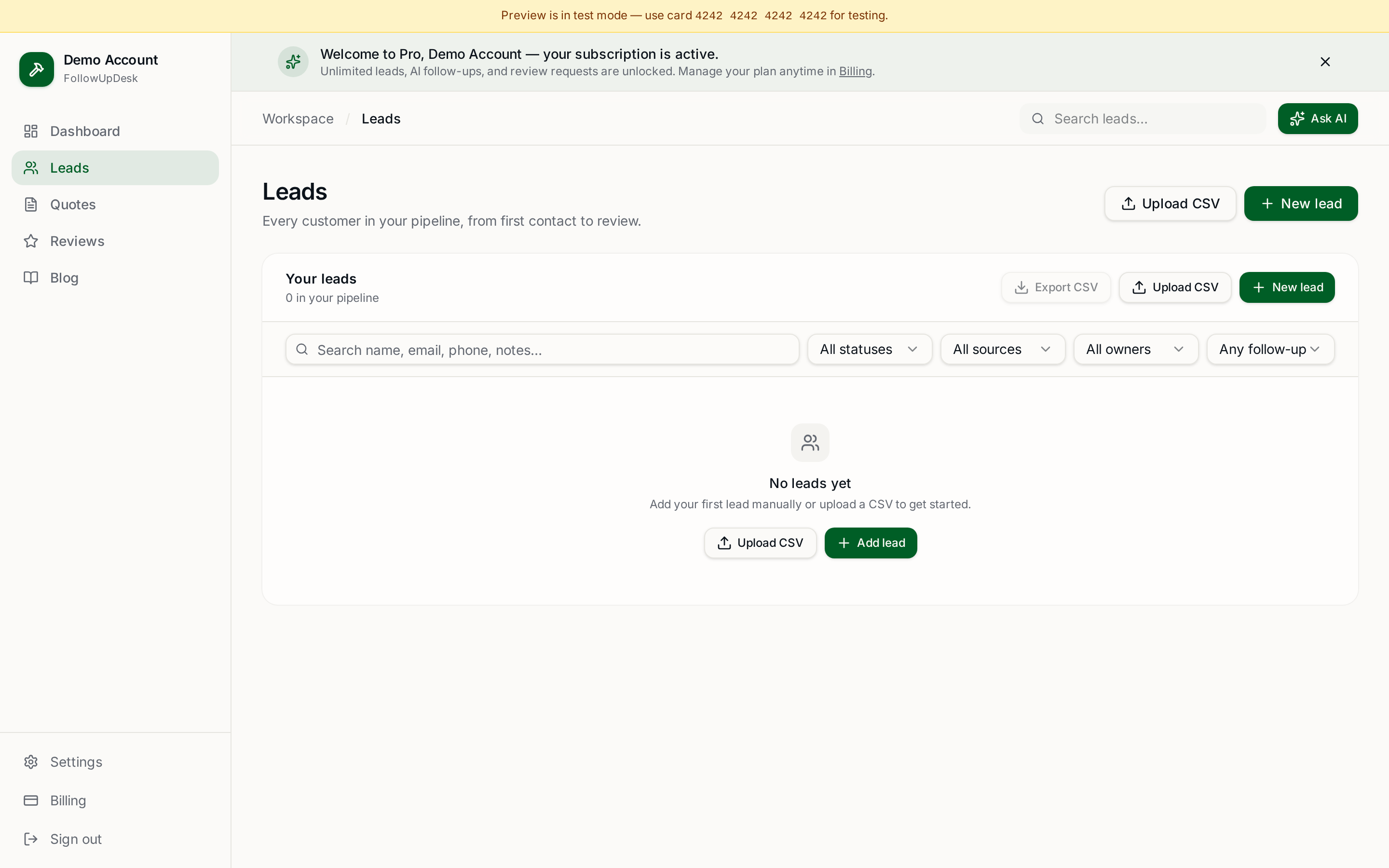
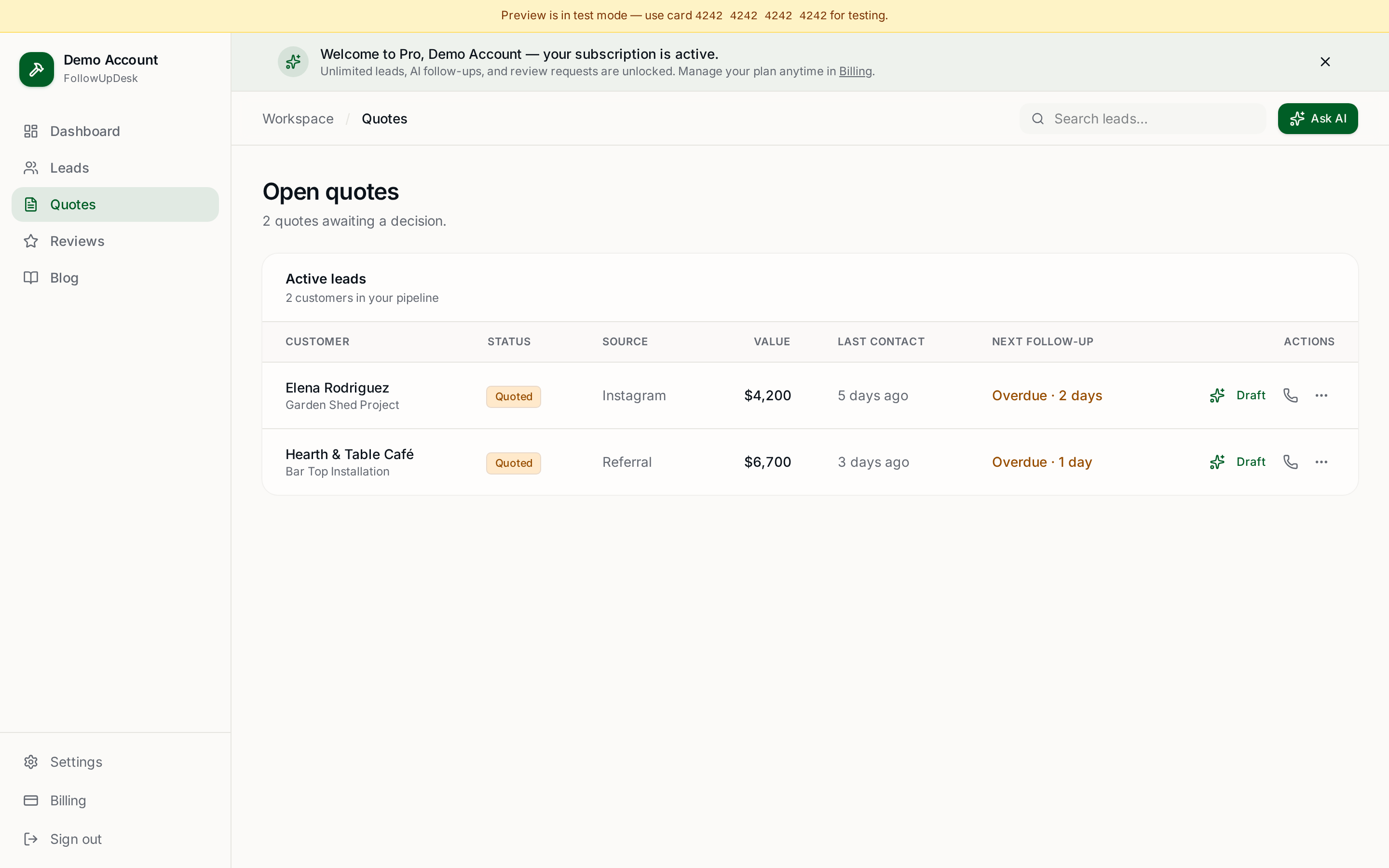
Build the cadence into a system so it runs without your attention. Whether that's a spreadsheet with reminder dates, a calendar that pings you, or a tool that drafts the AI-written nudges automatically — the system beats discipline every time.
If you want a head start, our free Quote Follow-Up Generator writes the day-3, day-7, and day-14 messages for you in 30 seconds — no signup needed.
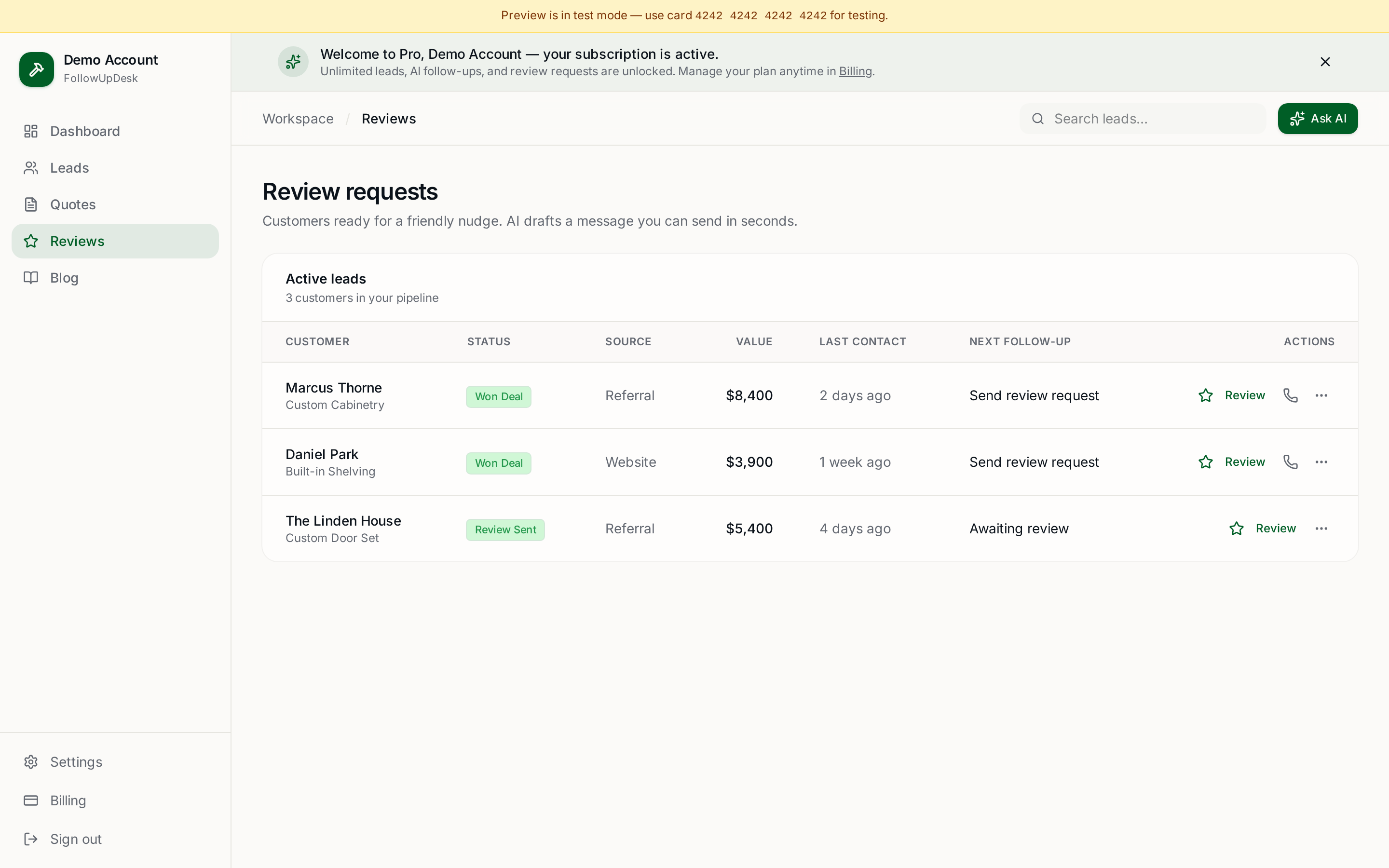
See it in FollowUpDesk
Get started — $29/mo →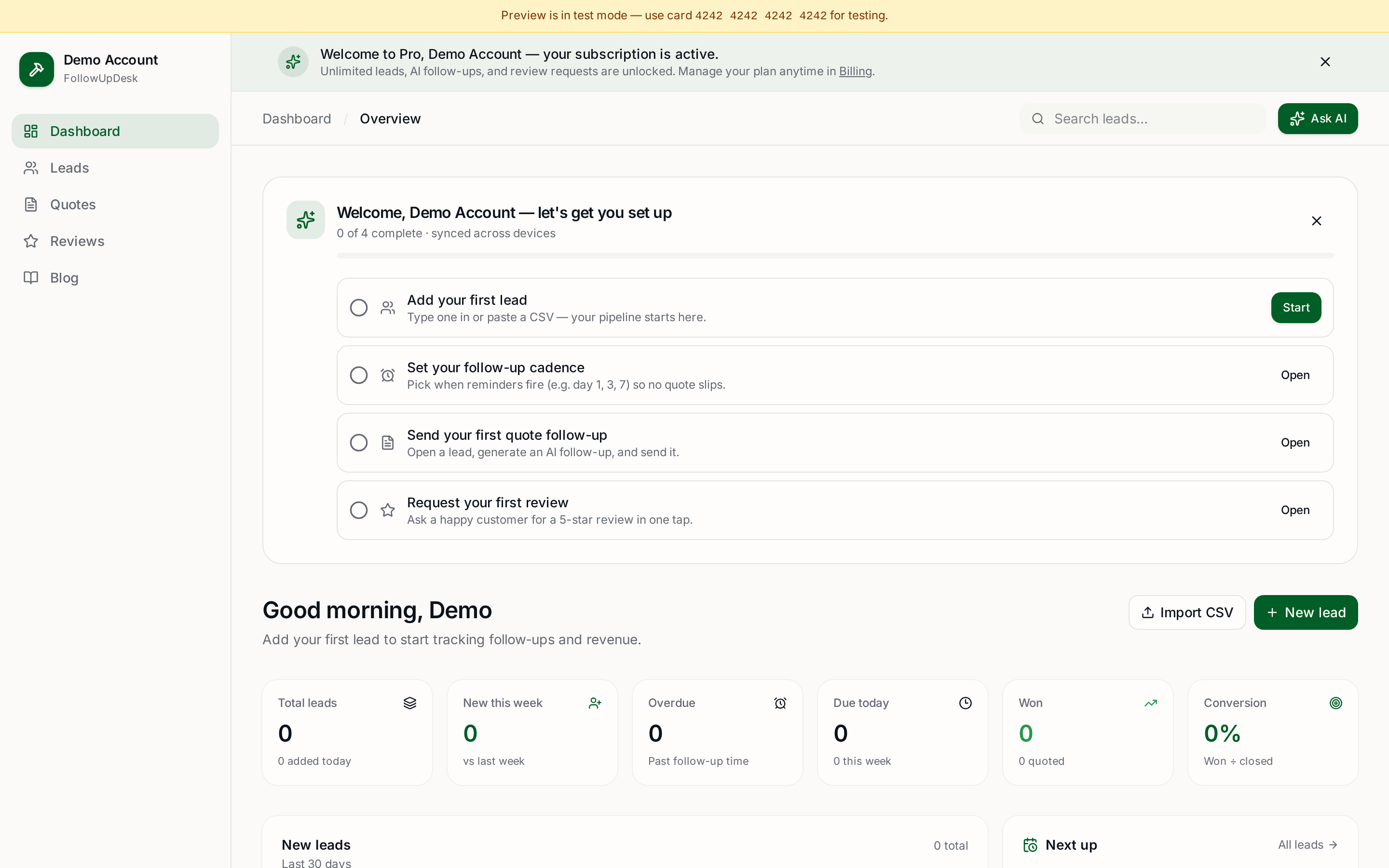
Skip the manual work — these are free, no card required
Frequently asked questions
How long should I wait to follow up on a quote?▾
Three business days for the first follow-up. Day 7 for a short text. Day 14 for a value-add email. Day 30 for a graceful close-out. Four touches over 30 days is the sweet spot.
How do you follow up on a quote by email?▾
Keep it to three lines: acknowledge the quote, offer to clarify or tweak it, and end with a yes/no question about a start date. Long re-pitches feel like sales pressure and convert worse than short check-ins.
What do you say when following up on a quote?▾
Lead with helpfulness ('happy to walk through anything that's unclear'), not pressure. Always give the customer an out — it actually increases responses, including yeses. Vary the angle each touch instead of resending the same ask.
How often should you follow up on a quote?▾
Four touches over 30 days for typical contractor jobs. Extend to 60 days and 6 touches for jobs over $10K. Compress to 10 days and 3 touches for jobs under $1K.
Is it rude to follow up on a quote?▾
No — customers expect it, and most appreciate it. Silence usually means they got busy, not that they decided against you. A polite, helpful check-in is professional, not pushy. Pushy is repeated identical messages with no value added.
Get the full FollowUpDesk CRM — $29/month
One pipeline for every lead, AI follow-ups for every quote, review requests on autopilot. Cancel in one click.
Free tools require no card · Pro is $29/month, cancel anytime